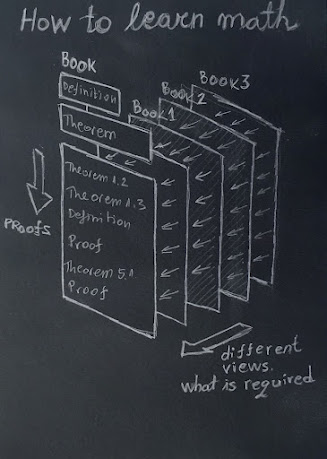
How to learn math. Reviewing several books with same topic opens different views on the same subject. Within a book you use definitions and previously proved theorems to prove new theorems. Postulating sets is essential. #education #math #engineering
Unlocking the secrets of quantitative reasoning. Rewiring your existing math knowledge into a new, powerful web of innovation generating ideas. Axioms Discovery, Axiomatic Frontiers, Directional Thinking, Specific Consequences, Logic, Intuition, Innovation, Invention.
Showing posts with label mathematics. Show all posts
Monday, February 21, 2022
Tuesday, April 24, 2012
Mathematics and Real World Applications Links. World #1 and World #2 Approach
You can download all the important posts as PDF book "Unlocking the Secrets of Quantitative Thinking".
In mathematics, it is all about numbers, sets of numbers, and the sequences of operations on them.
Axioms how to link real world scenarios to mathematical axioms and theorems, have to be defined. The closer you are to the point of complete axiomatization of the real world domains you want to apply math at, the better. Mathematics will reward you with meaningful results. Quantitative aspects of real world axioms, theorems and laws are usually theorems within mathematics.
How that can help you to learn mathematics and the domains where the mathematics is apply to, whatever that means? The answers is that you have to separate the two systems of axioms. The real world system, let's call it World #1 and the pure mathematical system (with its own axioms!), let's call it World #2. Note that there are World #1 axioms (ideally), World #2 axioms and axioms how to link the premises, and eventually theorems, from these two worlds.
If you quantify objects and their relationships in the World #1, the quantities, and their relations, you obtained enter mathematics as initial or boundary conditions, or simply as numbers, set of numbers, pairs of numbers, as the starting points or starting premises. Note that these numerical starting points can be obtained inside math as well, without any extraneous motivation, i.e. within the realm of pure math only, sometimes directly from fundamental axioms.
The interpretation of numerical results is, apparently, up to you. It is you who will keep track of what is counted and why. The logic why you would do certain mathematical operations on the specified numbers, if coming from World #1, has to be firm and, ideally, has to be derived from an firm axiomatic system. Of course, math doesn't care if you axiomatized your real world domain or not. Mathematics will, without asking any questions, follow your instructions for calculations, and give you back results. Interpretation and usage of those results will depend on the correctness of your real world domain assumptions, accuracy of its logic, and completeness and correctness of the real world domain axioms.
[ mathematics, real life math applications, learning math, teaching math, math applications, real world math applications ]
Friday, April 13, 2012
One More Example to Show What a Number Is and the Search for Truth in Various Disciplines
You can download all the important posts as PDF book "Unlocking the Secrets of Quantitative Thinking".
Here is one more interesting and quite good example to define a number, to show, in essence, what a number is.Let's say you have three apples on the table. Let's do the following
You can deal separately with pure number 3, without linkage to any of the objects it can represent the count of. That's pure math. Once you start keeping track what you count, applied math kicks in.
Of course, you are always (as in any scientific discipline) interested to find the truth. Here, you may want to be interested to find truths about numbers. That's where logic enters, with its initial assumptions, axioms, theorems, proofs. You, essentially, always want to prove what is true in math. Mathematicians are after the proofs about counts. Mathematicians are after what is true about numbers, counts and their relations. Lawyers are after the proofs what is true with regards to law, moral, what is right or wrong, and with regards to other human values. Physicists are after the truths in physical world, where various forces, energy, motions are central focus in their investigation. Story writers and movie makers are after the true emotions and true moral messages their work will convey and show, even with fictitious plots, i.e. no matter whether the story is fictional or not, the message about human values, be it emotional, moral, must be real and true, and this message will be true if the story line is logically consistent with the story's framework, no matter how fictional that framework may be.
Now, back to the first example, with apples, steps, seconds, pencils, pushups. Mathematics, while apparently common to all those cases, can not define the actual concepts it has counted. What differentiate an apple from a pushup, and a pushup from a pencil, and a pencil from a second is not part of mathematics, and mathematics is, more or less, not part at all of that analysis and those very important relationships. Moreover, it is these non mathematical relationships that define the various disciplines and it is these non mathematical relationships that very often dictate the direction of mathematical development. These relationships dictate what, when, where, and why will be counted, measured, if required at all.
You can download this post as an article in PDF file format by clicking on the picture below or from here.
[ mathematics, math, math tutoring, philosophy, cognitive, cognition, learning math, learning mathematics, number, count, number definition ]
Here is one more interesting and quite good example to define a number, to show, in essence, what a number is.Let's say you have three apples on the table. Let's do the following
- Do as many steps as you have apples on the table.
- Count or wait as many seconds as you have apples on the table.
- Count is many pencils as you have apples on the table.
- Do as many push ups as you have apples on the table.
You can deal separately with pure number 3, without linkage to any of the objects it can represent the count of. That's pure math. Once you start keeping track what you count, applied math kicks in.
Of course, you are always (as in any scientific discipline) interested to find the truth. Here, you may want to be interested to find truths about numbers. That's where logic enters, with its initial assumptions, axioms, theorems, proofs. You, essentially, always want to prove what is true in math. Mathematicians are after the proofs about counts. Mathematicians are after what is true about numbers, counts and their relations. Lawyers are after the proofs what is true with regards to law, moral, what is right or wrong, and with regards to other human values. Physicists are after the truths in physical world, where various forces, energy, motions are central focus in their investigation. Story writers and movie makers are after the true emotions and true moral messages their work will convey and show, even with fictitious plots, i.e. no matter whether the story is fictional or not, the message about human values, be it emotional, moral, must be real and true, and this message will be true if the story line is logically consistent with the story's framework, no matter how fictional that framework may be.
Now, back to the first example, with apples, steps, seconds, pencils, pushups. Mathematics, while apparently common to all those cases, can not define the actual concepts it has counted. What differentiate an apple from a pushup, and a pushup from a pencil, and a pencil from a second is not part of mathematics, and mathematics is, more or less, not part at all of that analysis and those very important relationships. Moreover, it is these non mathematical relationships that define the various disciplines and it is these non mathematical relationships that very often dictate the direction of mathematical development. These relationships dictate what, when, where, and why will be counted, measured, if required at all.
You can download this post as an article in PDF file format by clicking on the picture below or from here.
[ mathematics, math, math tutoring, philosophy, cognitive, cognition, learning math, learning mathematics, number, count, number definition ]
Sunday, February 19, 2012
The Definition of Number
You can download all the important posts as PDF book "Unlocking the Secrets of Quantitative Thinking".
After a number of years dealing with mathematics in your primary, secondary school, there still may be a question what the number is. Moreover, unless you are a professional mathematician, with PhD in your resume, I can safely assume that your frustration and fear of mathematics is still present.
What is a number? Seemingly popular approach I am using here does not reduce the strength and significant clarity of the definition. Bear with me, and listen carefully :-) You may find out many interesting things!
Here is the clearest approach to defining number.
Number is a count.
I will repeat again, number is a count. The purity and significance of this definition can not be emphasized more. While it is simple, it conveys many more important messages than other definitions and approaches you may have read about before. One of the most important message, in my view, of this definition is that it implicitly specifies what you can do with counts. Knowing what you can do with counts, you actually filter out all non mathematical concepts that may be mixed during "bad" mathematical lectures over the years. Also, thinking of numbers as counts, you define what pure mathematics is about! And that can help you answering the questions how math can be applied (about what "applied" means we will see later) in so many different fields, and what differentiate pure and applied math.
What you can do with counts is what mathematics is all about! So, what can you do with counts? You can add them, subtract them, divide, multiply. You can, then, do any number of these operations in any sequence you want. No apples, pears needed to do that! Count 5 is a universal count. It can come from counting apples, pears, cars, atoms, money, steps, seconds. That number 5, count 5 is a universal thing for all of them. While you can eat 5 apples, drive 5 cars, wait 5 seconds, with count 5 you can not do that. But you can add another number 5 to it! or deduct count of 3 from it. Or do any other "counting" operation! Note very important thing -> how you call these counts, i.e. are they integers, positive, negative, odd, even, rational, are just labels we attach and associate to the concept of a count! There is only count we are dealing it all the time.
Looking at count 5 only, i.e. number 5 only, you can not tell whether it came from apples, pears, or counting seconds. So, how you will differentiate count 5 of apples and count 5 of seconds if count, number is actually so universal concept? There is no other way than to keep track by yourself what you have counted. Technically, you will write a small letter beside the number, beside the count to remind you what it is a count of! Or you can remember that in your mind. Whatever works for you.
So, whenever you read about those exotic mathematical concepts, like matrices, determinants, integrals, equations, algebra, arithmetic, you will know one thing - it is all and only about pure counts we have just talked about. There is nothing else there. For instance, a matrix is a set of counts arranged in rectangular fashion on page. But, you do not need even that rectangle. You can just imagine in your mind the same set of counts and differentiate between them in any way you want. It just happened that it was convenient to write those numbers in a rectangular grid on paper! It was just convenience.
The logic, the reasoning in the world of counted objects is separate from the logic that deals only with counts. You can investigate properties of counts only, completely independent from the real world objects they might represent count of. This is the topic of mathematics. To find what is true about counts i.e. numbers. Hence the proof. But note here, we are really interested in counts' characteristics, no matter which objects have been counted! What these characteristics can be? We can have odd numbers, or even! We can have prime counts. Some counts can be divided by others, while some not. But, the numbers are numbers, it is us who give them names to keep track of some of their properties or just we want to deal with some numbers while leaving other numbers alone!. Naming numbers is not a mathematical operation. It just help us describe, label numbers, counts, we want to deal with.
We can compare the way we can deal with numbers to the way a sculptor deals with clay. It is only the clay that he works with and nothing else. Clay! But, what clay represents when it is shaped, what sculpture represents is not about clay! The motivation how the sculptor will twist, press, mold, shape clay is outside clay's world. Same in math! The reason why we add, subtract, divide, or even select numbers to deal with, frequently are outside mathematics! The motivation can come from us buying CDs or from an economist measuring supply and demand, or police measuring speed of the car.
Now, back to sculpture again. The sculpture can represent anything. The similar thing is with numbers. In mathematics we are dealing with numbers only, the same way sculptor deals only with clay! But, if we want to interpret math results and use math in some other fields then we will have to keep track what we have counted, measured, keep track which objects are numbers, counts associated with! That would be called applied math. And, again, the numbers can represent count of many, many different things.
In developing and understanding a subject, axioms come late. Then in the formal presentations, they come early. - Rueben Hersh.#math
The view that mathematics is in essence derivations from axioms is backward. In fact, it's wrong. - Rueben Hersh http://books.google.ca/books?id=R-qgdx2A5b0C&printsec=frontcover&dq=what+is+mathematics+really&hl=en&sa=X&ei=6O9BT5RIqdfRAcyqteMH&ved=0CDsQ6AEwAA#v=onepage&q=what%20is%20mathematics%20really&f=false
Now, back to sculpture again. The sculpture can represent anything. The similar thing is with numbers. In mathematics we are dealing with numbers only, the same way sculptor deals only with clay! But, if we want to interpret math results and use math in some other fields then we will have to keep track what we have counted, measured, keep track which objects are numbers, counts associated with! That would be called applied math. And, again, the numbers can represent count of many, many different things.
In developing and understanding a subject, axioms come late. Then in the formal presentations, they come early. - Rueben Hersh.
The view that mathematics is in essence derivations from axioms is backward. In fact, it's wrong. - Rueben Hersh http://books.google.ca/books?id=R-qgdx2A5b0C&printsec=frontcover&dq=what+is+mathematics+really&hl=en&sa=X&ei=6O9BT5RIqdfRAcyqteMH&ved=0CDsQ6AEwAA#v=onepage&q=what%20is%20mathematics%20really&f=false
[ number concept, concept of a number, number, count, numbers, counts, integers, rational numbers, concept, math, mathematics ]
Labels:
concept,
concept of a number,
count,
counts,
integers,
math,
mathematics,
number,
number concept,
numbers,
rational numbers
Friday, January 20, 2012
The Concept of a Mathematical Function
You can download all the important posts as PDF book "Unlocking the Secrets of Quantitative Thinking".
The concept of a mathematical function should not be first introduced as a formula, but as an arbitrary (ordered) pairs of numbers. Pupils are conditioned to think of a function as a continuous line or a firmula. Later there are issues with statistics when function is shown to be function a set of distinct dots, representing ordered pairs of numbers, i.e. there is no formula at all. Moreover, in probability and statistics numbers appear to be showing at random!
The rule how you pair one number with another can be a formula, but also can be a completely random event. Math function is, first and foremost about pairing two numbers (or more in multivariable functions). Students should be aware that they can pair random chosen numbers, they do not need to calculate second number from first. The rule can be linked input or output, but that restricts the function in the way that you have to know input to get the other paired number, the output. Because, function can have a pairing rule "pick first number, then, ask another person to pick another number without looking at the first number, then pair two numbers". Rule is one thing. Paired numbers are another. I want to emphasize that function need not to be defined in a restrictive way by using words "inputs" and “outputs", which is more related to computer science. You do not have to know input to get output, in a function. Both elements of the ordered pair of an function can be completely random and independent from each other. Function is first and foremost a pair of ordered numbers. My examples show why the \"input\" \"output\" definition is restrictive and possibly misleading. In my view, the word pair, or more precisely definition "ordered pair" best describes the function. Then we can use word map, association of two numbers etc. Input and output really leads someone to think that there need to be formula or some dependency between output and input. But, it is not so. It can be, but that's too restrictive for function definition. As in my example, a function can be "pick an output that in no way depends on input". Or, pick one number, then cover it (hide it) then ask another person to pick another number. Pair these two numbers. Here, output in no way depends on input, yet this is a function.
[ math function, function, concept of a function, concept of function, mathematics, map, mapping, teaching math ]
Monday, November 7, 2011
Real World Example of Natural Numbers
You can download all the important posts as PDF book "Unlocking the Secrets of Quantitative Thinking".
In real world application of math we have to keep track what we have counting, while pure math cares only about pure numbers.
This is an example of counting rounds in an UFC match (UFC - I do not approve nor like).
[ math, mathematics, math application, axioms, examples of natural numbers, natural numbers, axioms, sets, number theory, ]
Sunday, October 16, 2011
A Few Hints How to Introduce Mathematical Concepts
You can download all the important posts as PDF book "Unlocking the Secrets of Quantitative Thinking".
Teacher should postpone introduction of strange, exotic mathematical names and labels to, otherwise, most likely, easy to explain and easy to understand concepts in mathematics. Teacher should first explain mathematical concepts in terms of required sequence of mathematical operations on numbers and on sets involved and then introduce labels or historically accepted names for them. Most of us will agree that many of those names are there for historical reasons, and often they are confusing, misleading, and even intimidating (if Borel, Hausdorff needed so much work to prove that theorem or formulate it, what chances do I have?). To me, it is sometimes better to refer to a theorem by a number first, like Theorem 1, Theorem 2, … and only later assign historical names or other labels to reference them.
Math lectures sometimes look to students like putting misleading, cluttered, over-detailed traffic signs on an easy to use roads and highways.
But, what are we really doing or what we want to do when we say "introducing math concepts through A or B or C real world examples"? Do math concepts need to be introduced through real world examples at all? No, they don't. They can be derived or formulated directly from axioms. So, what would be the goal of "introducing math" through real world examples? To show that math concepts can be motivated by real life examples, but, at the same time the same math concepts can be derived inside math only, without referencing any real world domain. To me, the mandatory step of introducing some math concepts from real world example is to mandatory show that the same concept can be defined or derived from ZFC axioms. This would clearly show the border and connections, if you wish, at the same time, between applied math and pure math developed from ZFC axioms.
[introducing math, math ], math concepts, math education, mathematics, theorems ]
Labels:
introducing math,
math ],
math concepts,
math education,
mathematics
Sunday, July 31, 2011
Mathematical Proof for Enthusiasts - What It Is And What It is Not
You can download all the important posts as PDF book "Unlocking the Secrets of Quantitative Thinking".
With the term mathematical proof we want to indicate a logical proof, i.e. proof using logical inferences, in the field of mathematics. So, it should really be “a proof in the field of mathematics”. Also, we have to assume, and be fully aware, that proof must be “logical” anyway. There are really no illogical proofs. Proof that appears to be obtained (whatever that means) by any other way, other than using rules of logic, is not a proof at all. Assumptions and axioms need no proof. They are starting points and their truth values are assumed right at the start. You have to start from somewhere. If they are wrong assumptions, axioms, the results will show to be wrong. So, you will have to go back and fix your fundamental axioms.
When you have first encountered a need or a task for a mathematical proof, you may have asked yourself "Why do I need to prove that, it's so obvious!?".
We used to think that we need to prove something if it is not clear enough or when there are opposite views on the subject we are debating. Sometimes, things are not so obvious, and again, we need to prove it to some party.
In order to prove something we have to have an agreement which things we consider to be true at the first place, i.e. what are our initial, starting assumptions. That’s where the “debate” most likely will kick in. In most cases, debate is related to an effort to establish some axioms, i.e. initial truths, and only after that some new logical conclusions, or proofs will and can be done.
The major component of a mathematical proof is the domain of mathematical analysis. This domain has to be well established field of mathematics, and mathematics only. The proof is still a demonstration that something is true, but it has to be true within the system of assumptions established in mathematics. The true statement, the proof, has to (logically) follow from already established truths. In other words, when using the phrase "Prove something in math..." it means "Show that it follows from the set of axioms and other theorems (already proved!) in the domain of math..". Which axioms and theorems you will start the proof with is a matter of art, intuition, trial and error, or even true genius. You can not use apples, meters, pears, feelings, emotions, experimental setup, physical measurements, to say that something is true in math, to prove a mathematical theorem, no matter how important or central role those real world objects pr processes had in motivating the development of that part of mathematics. In other words, you can not use real world examples, concepts, things, objects, real world scenarios that, possibly, motivated theorems’ development, in mathematical proofs. Of course, you can use them as some sort of intuitive guidelines which axioms, or theorems, you will use to start the construction of a proof. You can use your intuition, feeling, experience, even emotions, to select starting points of a proof, to chose initial axioms or theorems in the proof steps, which, when combined later, will make a proof. But, you can not say that, intuitively, you know the theorem is true, and use that statement about your intuition, as an argument in a proof. You have to use mathematical axioms, already proved mathematical theorems (and of course logic) to prove the new theorems.
The initial, starting assumptions in mathematics are called fundamental axioms. Then, theorems are proved using these axioms. More theorems are proved by using the axioms and already proven theorems. Usually, it is emphasized that you use logical thinking, logic, to prove theorems. But, that's not sufficient. You have to use logic to prove anything, but what is important in math is that you use logic on mathematical axioms, and not on some assumptions and facts outside mathematics. The focus of your logical steps and logic constructs in mathematical proofs is constrained (but not in any negative way) to mathematical (and not to the other fields’) axioms and theorems.
Feeling that something is "obvious" in mathematics can still be a useful feeling. It can guide you towards new theorems. But, those new theorems still have to be proved using mathematical concepts only, and that has to be done by avoiding the words "obvious" and "intuition"! Stating that something is obvious in a theorem is not a proof.However, using own intuition to construct a proof or to formulate theorem is definitely useful.
Again, proving means to show that the statement is true by demonstrating it follows, by logical rules, from established truths in mathematics, as oppose to established truths and facts in other domains to which mathematics may be applied to.
As another example, we may say, in mathematical analysis, that something is "visually" obvious. Here "visual" is not part of mathematics, and can not be used as a part of the proof, but it can play important role in guiding us what may be true, and how to construct the proof.
Each and every proof in math is a new, uncharted territory. If you like to be artistic, original, to explore unknown, to be creative, then try to construct math proofs.
No one can teach you, i.e. there is no ready to use formula to follow, how to do proofs in mathematics. Math proof is the place where you can show your true, original thoughts.
[ set, set theory, concept of a set, sets in mathematics, real world, applied math, applied mathematics, axioms, math education, math proof, mathematical axioms, mathematical proof, mathematical theorems, mathematics, theorems, tutoring ]
Friday, July 22, 2011
Concept of a Set and of a Number
You can download all the important posts as PDF book "Unlocking the Secrets of Quantitative Thinking".
For instance, let's take a look at the cars on a highway, apples on a table, coffee cups in a coffee shop, pears in a basket. Without our initiative, our thought action, will, our specific direction of thinking, objects will sit on table or in their space undisturbed and unanalyzed. They are apples, cars, coffee cups, pears. But then, on the other hand, we can think of them in any way we wish. We can think how we feel about them, are they edible, we can think about theory of color, their social value, utility value, psychological impressions they make. We can think of them in any way we want or find interesting or useful, or we can think of them for amusement too. They are objects in the way they are and they need not to be members of any set, i.e. we don’t need to count them.
Now, imagine that our discourse of thought is to start thinking of them in terms of groups or collections, what whatever reason. Remember, it's just came to our mind that we can think of objects in that way. The fact that the apples are on the table and it looks like they are in a group is just a coincidence. We want to form a collection of objects in our mind. Hence, apples on a table are not in a group, in a set yet. They are just spatially close to each other. Objects are still objects, with infinite number of conceptual contexts we can put them in.
Again, one of the ways to think about them is to put them in a group, for whatever reason we find! We do not need to collect into group only similar objects, like, only apples or only cars. Set membership is not always dictated by common properties of objects. Set membership is defined in the way we want to define it! For example, we can form set of all objects that has no common property! We can form a group of any kind of objects, if our criterion says so. We can even be just amused to group objects together in our mind. Hence, the set can be specified as “all objects we are amused to put together”. Like, one group of a few apples, a car, and several coffee cups. Or, a collection of apples only. Or, another collection of cars and coffee cups only. All in our mind, because, from many directions of thinking we have chosen the one in which we put objects together into a collection.
Without our initiative, our thought action, objects will float around by themselves, classified or not, and without being member of any set! Objects are only objects. It is us who grouped them into sets, in our minds. In reality, they are still objects, sitting on the table, driven around on highways, doing other function that are intrinsic to them or they are designed for, or they are analyzed in any other way or within another scientific field.
Since, as we have seen, we invented, discovered a direction of thinking which did not exist just a minute ago, to think of objects in a group, we may want to proceed further with our analysis.
Roughly speaking, with the group, collection of objects we have introduced a concept of a set. Note how arbitrary we even gave name to our new thought that resulted in grouping objects into collections. We had to label it somehow. Let's use the word set!
Now, if we give a bit more thought into set, we can see that set can have properties even independent of objects that make it. Of course, for us, in real world scenarios, and set applications, it is of high importance whether we counted apples or cars. We have to keep tracks what we have counted. However, there are properties of sets that can be used for any kind of counted objects. Number of elements in a set is such one property. If we play more with counts and number of elements in a set we can discover quite interesting things. Three objects plus six objects is always nine objects, no matter what we have counted! The result 3 + 6 = 9 we can use in any set of objects imaginable, and it will always be true. Now, we can see that we can deal with numbers only, discover rules about them, in this case related to addition that can be used for any objects we may count.
Every real world example for mathematics can generate mathematical concepts, mainly sets, numbers, sets of numbers, pair of numbers. Once obtained, all these pure math concepts can be, and are, analyzed independently from real world and situations. They can be analyzed in their own world, without referencing any real world object or scenario they have been motivated with or that might have generate them, or any real world example they are abstracted from. How, then, conception of the math problems come into realization, if the real world scenarios are eliminated, filtered out? Roughly speaking, you will use word “IF” to construct starting points. Note that this word “IF” replaces real world scenarios by stipulating what count or math concept is “given” as the starting point.
But, it is to expect. Since a number 5 is an abstracted count that represents a number of any objects as long as there are 5 of them, we can not, by looking at number 5, tell which objects they represent. And we do not need to that since we investigate properties of sets and numbers between themselves, like their divisibility, which number is bigger, etc. All these pure number properties are valid for any objects we count and obtain that number! Quite amazing!
Moreover, even while you read a book in pure math like "Topology Fundamentals" or "Real Variable Analysis" or "Linear Algebra" you can be sure that every set, every number, every set of numbers mentioned in their axioms and theorems can represent abstracted quantity, common count, and abstracted number of millions different objects that can be counted, measured, quantified, and that have the same count denoted by the number you are dealing with. Hence you can learn math in the way of thinking only of pure numbers or sets, as a separate concepts from real world objects, knowing they are abstraction of so many different real world, countable objects or quantifiable processes (with the same, common count), or, you can use, reference, some real world examples as helper framework, so to speak, to illustrate some of pure mathematical relationships, numbers, and sets, while you will still be dealing, really, with pure numbers and sets.
There may be, also, a question, why it is important to discover properties of complements, unions, intersections, of sets, at all? These concepts look so simple, so obvious, how such a simple concepts can be applied to so many complex fields?
Let’s find out! Looking at sets, there is really only a few things you can do with them. You can create their unions, intersections, complements, and then find out their cardinalities, i.e. sizes of sets, how many elements are there in a set. There is nothing else there. Note how, in math, it is sufficient to declare sets that are different from each other, separate from each other. You don’t have to elaborate what are the sets of, in mathematics. You do not even need to use labels for sets, A, B, C,… It’s sufficient to imagine two (or more) different sets. In mathematics, there are no apples, meters, pears, cars, seconds, kilograms, etc. So, if we remove all the properties of these objects, what properties are left to work with sets then? Now, note one essential thing here! By working with sets only, by creating unions, complements, intersections of sets, you obtain their different cardinalities. And, in most cases, we are after these cardinalities in set theory, as one of the major properties of sets, and hence in mathematics. Roughly speaking, cardinality is the size of a set, but also, after some definition polishing, it represents a definition of a number too. Hence, if we get a good hold on union, complement, intersection constructions and identity when working with sets, we have a good hold on their cardinalities and hence counts and numbers. And, again, that's what we are after, in general, in mathematics!
As for real world examples, you may ask, how distant is set theory or pure mathematical, number theory from real world applications? Not distant at all. Remember the fact how we obtained a number? A number is an abstraction of all counted objects with the same count, of all sets of objects with the same number of elements (apples, cars, rockets, tables, coffee cups, etc). Hence, the result we have obtained by dealing with each pure, abstracted number can be immediately applied to real world by deciding what that count represents or what objects we will count that many times. Or, the other way is, even if we dealt with pure math, pure numbers all the time, we would've kept track what is counted, with which objects we have started with. There is only one number 5 in mathematics, but in real world applications we can assign number 5 to as many objects as we want. Hence, 5 apples, 5 cars, 5 rockets, 5 thoughts, 5 pencils, 5 engines. In real world math applications scenarios it matter what you have counted. But that fact and information, what you have counted (cars, rockets, engines, ..) is not part of math, as we have just seen. Math needs to know only about a specific number obtained. Number 5 obtain as a number of cars is the same as number 5 obtained from counting apples, from the mathematical point of view. But, it can and does represent sizes of two sets, cars and apples. For math, it is sufficient to write 5, 5 to tell there are two counts, but for us, it is practical to drag a description from the real world, cars, apples, to keep track what number 5 represents.
[ concept of a set, math, math tutoring, mathematics, number concept, number definition, numbers, set, set concept, sets and numbers, tutoring ]
For instance, let's take a look at the cars on a highway, apples on a table, coffee cups in a coffee shop, pears in a basket. Without our initiative, our thought action, will, our specific direction of thinking, objects will sit on table or in their space undisturbed and unanalyzed. They are apples, cars, coffee cups, pears. But then, on the other hand, we can think of them in any way we wish. We can think how we feel about them, are they edible, we can think about theory of color, their social value, utility value, psychological impressions they make. We can think of them in any way we want or find interesting or useful, or we can think of them for amusement too. They are objects in the way they are and they need not to be members of any set, i.e. we don’t need to count them.
Now, imagine that our discourse of thought is to start thinking of them in terms of groups or collections, what whatever reason. Remember, it's just came to our mind that we can think of objects in that way. The fact that the apples are on the table and it looks like they are in a group is just a coincidence. We want to form a collection of objects in our mind. Hence, apples on a table are not in a group, in a set yet. They are just spatially close to each other. Objects are still objects, with infinite number of conceptual contexts we can put them in.
Again, one of the ways to think about them is to put them in a group, for whatever reason we find! We do not need to collect into group only similar objects, like, only apples or only cars. Set membership is not always dictated by common properties of objects. Set membership is defined in the way we want to define it! For example, we can form set of all objects that has no common property! We can form a group of any kind of objects, if our criterion says so. We can even be just amused to group objects together in our mind. Hence, the set can be specified as “all objects we are amused to put together”. Like, one group of a few apples, a car, and several coffee cups. Or, a collection of apples only. Or, another collection of cars and coffee cups only. All in our mind, because, from many directions of thinking we have chosen the one in which we put objects together into a collection.
Without our initiative, our thought action, objects will float around by themselves, classified or not, and without being member of any set! Objects are only objects. It is us who grouped them into sets, in our minds. In reality, they are still objects, sitting on the table, driven around on highways, doing other function that are intrinsic to them or they are designed for, or they are analyzed in any other way or within another scientific field.
Since, as we have seen, we invented, discovered a direction of thinking which did not exist just a minute ago, to think of objects in a group, we may want to proceed further with our analysis.
Roughly speaking, with the group, collection of objects we have introduced a concept of a set. Note how arbitrary we even gave name to our new thought that resulted in grouping objects into collections. We had to label it somehow. Let's use the word set!
Now, if we give a bit more thought into set, we can see that set can have properties even independent of objects that make it. Of course, for us, in real world scenarios, and set applications, it is of high importance whether we counted apples or cars. We have to keep tracks what we have counted. However, there are properties of sets that can be used for any kind of counted objects. Number of elements in a set is such one property. If we play more with counts and number of elements in a set we can discover quite interesting things. Three objects plus six objects is always nine objects, no matter what we have counted! The result 3 + 6 = 9 we can use in any set of objects imaginable, and it will always be true. Now, we can see that we can deal with numbers only, discover rules about them, in this case related to addition that can be used for any objects we may count.
Every real world example for mathematics can generate mathematical concepts, mainly sets, numbers, sets of numbers, pair of numbers. Once obtained, all these pure math concepts can be, and are, analyzed independently from real world and situations. They can be analyzed in their own world, without referencing any real world object or scenario they have been motivated with or that might have generate them, or any real world example they are abstracted from. How, then, conception of the math problems come into realization, if the real world scenarios are eliminated, filtered out? Roughly speaking, you will use word “IF” to construct starting points. Note that this word “IF” replaces real world scenarios by stipulating what count or math concept is “given” as the starting point.
But, it is to expect. Since a number 5 is an abstracted count that represents a number of any objects as long as there are 5 of them, we can not, by looking at number 5, tell which objects they represent. And we do not need to that since we investigate properties of sets and numbers between themselves, like their divisibility, which number is bigger, etc. All these pure number properties are valid for any objects we count and obtain that number! Quite amazing!
Moreover, even while you read a book in pure math like "Topology Fundamentals" or "Real Variable Analysis" or "Linear Algebra" you can be sure that every set, every number, every set of numbers mentioned in their axioms and theorems can represent abstracted quantity, common count, and abstracted number of millions different objects that can be counted, measured, quantified, and that have the same count denoted by the number you are dealing with. Hence you can learn math in the way of thinking only of pure numbers or sets, as a separate concepts from real world objects, knowing they are abstraction of so many different real world, countable objects or quantifiable processes (with the same, common count), or, you can use, reference, some real world examples as helper framework, so to speak, to illustrate some of pure mathematical relationships, numbers, and sets, while you will still be dealing, really, with pure numbers and sets.
There may be, also, a question, why it is important to discover properties of complements, unions, intersections, of sets, at all? These concepts look so simple, so obvious, how such a simple concepts can be applied to so many complex fields?
Let’s find out! Looking at sets, there is really only a few things you can do with them. You can create their unions, intersections, complements, and then find out their cardinalities, i.e. sizes of sets, how many elements are there in a set. There is nothing else there. Note how, in math, it is sufficient to declare sets that are different from each other, separate from each other. You don’t have to elaborate what are the sets of, in mathematics. You do not even need to use labels for sets, A, B, C,… It’s sufficient to imagine two (or more) different sets. In mathematics, there are no apples, meters, pears, cars, seconds, kilograms, etc. So, if we remove all the properties of these objects, what properties are left to work with sets then? Now, note one essential thing here! By working with sets only, by creating unions, complements, intersections of sets, you obtain their different cardinalities. And, in most cases, we are after these cardinalities in set theory, as one of the major properties of sets, and hence in mathematics. Roughly speaking, cardinality is the size of a set, but also, after some definition polishing, it represents a definition of a number too. Hence, if we get a good hold on union, complement, intersection constructions and identity when working with sets, we have a good hold on their cardinalities and hence counts and numbers. And, again, that's what we are after, in general, in mathematics!
As for real world examples, you may ask, how distant is set theory or pure mathematical, number theory from real world applications? Not distant at all. Remember the fact how we obtained a number? A number is an abstraction of all counted objects with the same count, of all sets of objects with the same number of elements (apples, cars, rockets, tables, coffee cups, etc). Hence, the result we have obtained by dealing with each pure, abstracted number can be immediately applied to real world by deciding what that count represents or what objects we will count that many times. Or, the other way is, even if we dealt with pure math, pure numbers all the time, we would've kept track what is counted, with which objects we have started with. There is only one number 5 in mathematics, but in real world applications we can assign number 5 to as many objects as we want. Hence, 5 apples, 5 cars, 5 rockets, 5 thoughts, 5 pencils, 5 engines. In real world math applications scenarios it matter what you have counted. But that fact and information, what you have counted (cars, rockets, engines, ..) is not part of math, as we have just seen. Math needs to know only about a specific number obtained. Number 5 obtain as a number of cars is the same as number 5 obtained from counting apples, from the mathematical point of view. But, it can and does represent sizes of two sets, cars and apples. For math, it is sufficient to write 5, 5 to tell there are two counts, but for us, it is practical to drag a description from the real world, cars, apples, to keep track what number 5 represents.
[ concept of a set, math, math tutoring, mathematics, number concept, number definition, numbers, set, set concept, sets and numbers, tutoring ]
Monday, July 18, 2011
Twitter - Insights About Creative Thinking, Science, Mathematics, Logic, Intution, Innovation.
You can download all the important posts as PDF book "Unlocking the Secrets of Quantitative Thinking".
Science is way more than math and logic. Math and logic can be equally applied do dogmatic teachings as well. Specific assumptions are the ones that define science.
Scientific thinking is much more than math. Quantification is often necessary but in no way sufficient condition for a scientific discover.
Human values are the ones that can relate, connect different axiomatic systems, and make them work together. It is the framework of human values that dictates which selection of theorems from different axiomatic systems we will make.
Math and logic do not imply right away that scientific thinking takes place. Math and logic will equally well serve any non scientific thinking, like a dogmatic teaching. It is the assumptions that differentiate scientific from non-scientific direction of thinking. Scientific assumptions are the ones that wins. Math and logic just serve them well.
Mathematics is defined not by objects it counts, nor by reasons or logic why those objects are counted, but with concepts used to define mathematics axioms and to define proofs of mathematical theorems.
In real world mathematics application, it is you who guides quantification. Guided quantification is the core of free applied math thinking.
Numbers have properties of their own, independent of anything else. Hence, real world can only specify starting points for calculations, and perhaps the sequence of numerical operations, but it can not influence, or change, in any way, these intrinsic properties of numbers within the mathematical system. And, on the other hand, a mathematical system, or numbers' properties, can not tell to which particular real world example they may be applied or be relevant to.
Allow complete creative freedom to play with initial assumptions then use strict logic to find true consequences.
It is the interplay of imaginative assumptions that lead to discovery. Only after the nested assumptions interplay logic should kick in.
Feel free to assume, propose anything you can imagine and only after that use logic and maybe math, to explore validity of your assumptions.
Logic and (possibly) some quantification should only be good servants to your uninhibited, creative, free thinking and assumptions play.
Logic can tell you if your assumption, premise is wrong. But logic, then, cannot tell you what would be the correct assumption or premise.
You use logic to TEST your assumptions. Logic hardly can help you to discover the correct assumption at the first place.
Behind all math initial premises and starting numbers may be a real world story explaining why the premises are there.
You can assume anything then apply correct logic. Only consequences will prove if your assumptions were true/correct.
Intuition, common sense, and experience probably served as the first quantitative tools for price setting. - "Energy Risk" by D. Pilipovic.
A mathematical model of a process is a set of premises driven by world extraneous to math yet they can be derived directly from math axioms
Force, energy, speed, momentum, inertia are not part of math. If they were, then math theorems will be proved using them. It's not the case.
What you may have to tell your primary school students when explaining math and a concept of a number - http://t.co/PkI7VdQ
Math can't tell real world from fictional one! Look! If Harry Potter flies 10 m/s how many meters he will advance after flying 5 seconds?
The very moment you said "as many apples as oranges" you defined the concept of a pure number. Moreover, no need to name the number.#math
More magic than in a new Harry Potter movie - take a journey from real world math applications to pure math and back http://t.co/PkI7VdQ
Take a thought journey from real world math applications to pure math and back - and have that "wow!" moment http://t.co/PkI7VdQ
Labeling a number generation as "random" is not part of mathematics. It's an attempt to describe some number selection by ordinary language.
Everyone, especially primary and secondary school math teachers, may consider reading Paul Lockhart's "A Mathematician's Lament".
To develop all mathematics you do not need a single other science. No need for physics, quantum physics, genetics, quantum chemistry,...
Whole math can be developed inside heads of mathematicians, without any pencil, paper, given they have enough big memory.
Math for [insert the field of application here]. It only means that you decide WHAT is counted and why. Math axioms and theorems remain the same!!
How math can be applied to so many different fields and how we can use math in real life http://t.co/17QRRxV
Math is not about following directions, it's about making new directions. - Paul Lockhart, "A Mathematician's Lament"..
If you asked yourself Can I revisit my math from primary and secondary school and finally understand what is it about? http://t.co/17QRRxV
In order to even begin to count something, you have to know legal system, exchange rules, physics laws, economic laws, how to measure, ..
While membership to a set is not defined within math, it has exotic names outside it: transaction, ownership, buy, sell, exchange, measure..
The very method we quantify something (like measurement) is not a part of mathematics! Set and membership to a set are undefined within math.
Why would you use real world example for a math concept when you can derive it directly from axioms? Both approaches should be demonstrated.
Logical truth values entered the irrational world of emotionality with the statement 'true love'.
Logical truth values entered the emotional world of irrationality with the statement 'true love'.
To me, two core concepts to know for aircraft design are combustion reaction energies (bond energies, fuel, oxygen) and airfoil physics.
More than 20 motivational examples to introduce rational numbers to kids. Pirates, scuba diving, text messaging, pets ..http://t.co/j7N6QAc
You don't deny student's hate towards math, nor try to change it directly. Instead, you accept it and integrate their hate in math puzzles.
Field of math application shapes the math development in the same way the landscape shapes and guides the roads going through them.
While pure math is like building roads just to build them, applied math is like building roads through landscapes you want to go through.
Math lectures sometimes look to students like putting misleading, cluttered, over-detailed traffic signs on easy to use roads and highways.
It is way better to first explain math concepts in terms of required operations and sets of numbers they apply to, and only after that.....to label them with historical, outdated, misleading, confusing names that contribute nothing to the concept's definition.
It is way better to first explain math concepts in terms of required operations and sets of numbers they apply to, and only after that...
To calculate racing track length you need limit concept. For racing car fuel usage you need rational numbers. Teach both at the same time.
Knowing how to implement a business rule in C++ can make you a living. Knowing what business rule you will implement can make you a fortune.
Math and physics concepts should be think of only by the ways they are calculated. Ordinary language names are confusing, often misleading.
We talk about selling, buying, getting, sending energy, but energy is not an object. It's a calculated value from measuring mass, time, distance.
Internal combustion engine principle for beginners. Combustion is, in essence, an electrical reaction. - http://t.co/qxk6PF5
Different contexts will give different meanings for the same sentence. #semiotics
From real world math applications to pure math and back! http://t.co/PkI7VdQ
For many students, math looks like a maze. Students are lost in one area of maze while real fun with math is in the other part of maze.
High school math programs are like labyrinth for students. Students should get a hot balloon and take a bird view look where they are.
Student hates math? Integrate his resistance points, reasoning, into the math problems. Student will realize that he dictates quantification.
Student hates math? Milton Erickson wrote about utilizing person's resistance to a subject to, actually, achieve goal person is resisting to.
Motivation & Math for students who hate math. Ask what is the percentage of time they would do math compared to what they like to do daily.
Here is one motivational math example. Ask your students in how many ways they HATE math.
Awareness - making visible new axiomatic system not known to exist before. Truths presented in order to take action i.e. derive theorems.
Aeronautical Engineering, Aerodynamics, Aircraft Design References http://t.co/nce2gAQ #aviation #aircraftdesign
Math and magazine design. Designer has to know how to fit actor's surface area to the page dimensions. Lower and upper bound...
Emotions and math? He wrote very emotional Acknowledgment in his new book on Advanced Calculus.
Applied math can not be solely credited to the achievements in the applied field. Field dictates what, when, why is to be calculated.
Grammar can not be credited for a beauty of a literary work. Many stupid things are said using perfect grammar, and vice versa.
Saying that math is backbone of things is like saying that grammar is backbone of every single novel, science paper, literary work created.
From ZFC axioms you can create all math. Yet, it is the world extraneous to math (often non-axiomatized) that dictates math development.
Axiomatizing one system strangely isolate reasoning world outside of that system, thus hiding the motivation logic for system's theorems.
Once you hear word "axioms" (in any system), look for logic extraneous to that system. That's where motivation for theorems is coming from.
Motivational Math. Introducing Math Through Car Racing Concepts. Stay tuned for a new, exciting article! http://t.co/4ibp7w8
Even if you manage to, somehow, quantify right and wrong, you still need their firm definitions to be sure you are not quantifying..apples.
Whenever, in a physics textbook, you see phrase "arbitrary" (magnetic, electric field...), it's a placeholder for a design driven value.
Many math proofs start with "Let's assume...". But, wait! Can you explain where that starting assumption comes from?? #mathed
Assumptions coming from non-axiomatized fields (physics, economics, finance) can wreak havoc when used in a strict axiomatic system (math).
If mathematicians are so proud of their axiomatic approach, why they deal at all with applied math in non axiomatized fields??
How we are allowed at all to go from non axiomatic world, physics, economics,finance, to so strictly defined axiomatic world of mathematics?
You don't learn math, then apply it. Newton didn't learn calculus first (there was none, he invented it!), then applied it to physics.
While a proof, in math, has to be very logical and precise, the genesis of it is usually described as art or unexplainable inspiration.
Strict, precise Newton's Law of Gravitation does not prevent you to enter into it a completely random number for mass or distance.
Length of a musical note as a mathematical property has way less significance than emotional perception of the sound (note) of that length.
Surface and volume integrals should be explained using tattoos. They are a good example for arbitrary surface and ink volume calculation.
Things You Always Wanted to Know About Math * But Were Afraid to Ask http://t.co/PkI7VdQ
From Real World Math Applications to Pure Math and Back http://t.co/PkI7VdQ
You spent all your school years dealing with continuous functions only to hear after they are very small number of all functions of interest.
When I hear "it's just continuous function"..bad! No, it's not "just"! It took hundreds years to come up with the definition of continuity.
I would ban phrases "it's simply...(that)", "it's just...(that)" in math. Please leave to student to judge is it complicated or simple.
It's useful to quantify, but, relationships that are quantified are OFTEN quite non-mathematical.
A math proof, once you do it, is probably the only thing in math you are not obliged to explain your teacher how you did it.
Logic used in math proofs is the same as logic used in law. But, in law, axioms are fluid, relative, changing. Law is doing best it can!
Using logic or not, people are making decisions each and every day..
Can you master math? I think, yes! http://t.co/1J31IRE
Explaining essential ideas of mathematics. Talk about Applied Mathematics, Mathematics and Real World, Math Education. http://t.co/aVTTz4v
Puzzled with math graphs? Wondered why they use them? Where the graphs come from anyway?? http://t.co/lGLUfHq
Math and Film. "They had tied up all mathematics of plots and substructures and sub-characters." -Johnny Depp, interview, Cineplex Magazine.
Overheard in student cafe: Math text often starts with 'Lets suppose..'. I don't want to suppose anything, especially something THAT complex.
You can quantify and calculate as much as you want, but if you don't think scientifically, mathematics can't help you.
There are many scientific discoveries that has nothing to do with quantification nor math.
Math may be necessary, but definitely it's not sufficient part to make progress in science.
Every proof should be constructed within known and accepted axiomatic system, being it physics, math, economics, law, engineering.
An explosion into unknown..http://explainingmath.blogspot.com
The posts are terrific. They engulf! http://explainingmath.blogspot.com
Usage of a math theorem is in NOT dependent AT ALL on the way theorem is proved. How you use a theorem has nothing to do with its proof.
To understand a math proof is way easier than to make a proof, in the same way it's easier to consume a movie than to make it, or to appreciate an art painting than to make it.
There is no straightforward path how to prove math theorems, as there is no law that can predict what number you will chose right...NOW.
Updated article why graphs are chosen to visually represent quantities in math, physics, economics etc...http://t.co/lGLUfHq
At some point teachers should stop explaining math concepts with real world examples because none of theorems are proved by using apples.
Mathematics can not be Queen of all sciences because you can't start only with math and develop other sciences. Science is there first.
Math without science, i.e. without science to tell WHAT is counted and WHY is just play with numbers (but elegant, logical, often exciting).
At some point teachers should stop explaining math concepts with real world examples becuase none of theorems are proved by using apples.
Even word "RANDOM" does not belong to math. It's outside math as is measurement, observation, guess etc. Math sees only numbers given to it.
How to Teach Your Kids and Yourself to Think More Freely About Math and Real World Math Applications ... http://t.co/1J31IRE
Teachers should clearly explain the difference between lingustic framework within which math tasks are described and pure math itself. #math
Since differential equation specifies only the difference between two quantities, it can not tell you with which quantities to start with.
Math can't tell you what to count. Math deals only with numbers and a result of any math task is a number, and a number only.
Hockey, Physics, Axioms and Where Innovations Come From..http://t.co/ZGwvm6y #hockey #physics #innovation
Imagine creating rules of the game what to do with numbers. Then, new theorems will be dictated by this game. Without game - no theorems.
In math it is YOU who creates territory and then investigate its properties and boundaries.
If you want popular introduction to rational, irrational numbers you may want to read "Essays on the Theory of Numbers" by Richard Dedekind.
How to approach numerical values in a physics formula. How to much better understand and use physics formuls...http://t.co/i2vNn6J #physics
I would strongly recommend "Essays on the Theory of Numbers" by Richard Dedekind. Detailed and non boring introduction to continuity.
Math is not prerequisite for real world applications. Newton did not learn calculus then applied it. He invented calculus!
What would you like to do, what you have a talent for, and what economy, i.e.market is looking for can hardly be all found in one job.
During schooling (don't mix that with education!) best thing you can do is to follow your own ideas and ask, then answer your own questions.
Motivation to Use Graphs in Math, Physics and to Know Arbitrary Surface Area Calculations, http://goo.gl/gPXFE
Quantitative finance, dragons, and math - http://goo.gl/XEDL3
Relationships between dragons lead to math development... http://goo.gl/XEDL3
Math can be motivated by real world or by fictional world. It can also be developed independently from both worlds. Student should know that.
Math can't distinguish between REAL world and FAIRY TALE! Check this. Two dragons ate 53kg of coal each. How much coal they ate together?
You can assign EXACT number to any RANDOM event! :-)
In many cases, relationships (between objects) that define WHAT has to be calculated are far more interesting than calculations themselves.
Value of calculus: when you find something interesting to calculate, it can help! The trick is to find something enjoyable to analyze.
You can understand calculus too! How to Calculate Surface Area of an Arbitrary Shape - Story of Pirate Island http://goo.gl/hbVEY
Math deals ONLY WITH NUMBERS, COUNTS. However, math can be used in real life once you start keeping track WHAT is counted and why.
It is seldom that an airfoil camber line can be expressed in simple geometric or algebraic forms. Important illustration of a math function!
Sure, mathematics can make you think better, especially if YOU set and define ORIGINAL problems, and not only solving what you are told to.
Airplanes, pirates, treasure hunt - how to introduce calculus ideas to primary school students. http://goo.gl/9uaPr
More about Setology and Countology here http://goo.gl/rAPWx #math #mathematics
Mathematics = Setology. A science about sets. :-)
Mathematics = Countology. It's a science about counts. Sort of better than Numerology :-) Count is a required action that gives a number!
How math can be applied to so many different fields and how we can use math in real life http://goo.gl/cJQxs
Students are afraid to PICK a number by themselves. They think each number has to be calculated, obtained in some complicated manner.
Stochastic process PICKS a number. Physical measurement PICKS a number. Picking a (closer and closer) number is ESSENCE of limit definition.
Physical or any process doesn't "generate" numbers. It PICKS numbers. Numbers are already generated, defined inside mathematics.
Graph is an invention of using length as a representation of ANY imaginable measurable quantity or number.
Introducing math function to students: first step should be to let students draw an arbitrary curve and show it represents PAIRED numbers.
"Our education plays a trick with us, leading us to believe things which are not correct." BBC Environment, Geometry, http://goo.gl/BaFKQ
Many are looking for real world examples of math. But, math can't tell what is real and what's not! 5 dragons plus 3 dragons = 8 dragons!
You apply math only AFTER you chose WHAT to count. Hence, choosing WHAT to count and WHY it is counted has nothing to do with math!
Have you ever wanted to know what are the fundamental ideas in calculus? http://goo.gl/aVDbv
But, you don't have to even say "Trust me, I am a lair.". You can just say "I am a lair.". It's already a paradox.
Journey to the Pirate's Island to learn calculus ideas...like a treasure hunt, sort of..http://goo.gl/hbVEY
Have you ever thought what's behind calculus ideas? Maybe this will show just that! http://goo.gl/hbVEY #math #calculus
How to introduce calculus concepts to primary school students: "How to Calculate Surface Area of a Pirate Island" http://goo.gl/hbVEY
After they master basic algebraic operations, primary school students should be encouraged to define new math problems by themselves. #math
Here is my illustration of the Pirates Island at night, which will be used to introduce integration to students, http://goo.gl/BipFE
My new draft post "How to Calculate Surface Area of a Pirate Island" introducing integration to primary school students http://goo.gl/rVY1D
Many students see math, if not whole formal education, as a tunnel from which they have to get out, eventually, to do what they want.
How the rational numbers should be introduced to kids, http://goo.gl/dhUmS #math #rationalnumbers
Once we realize that math deals only with sets and numbers and that math does not need real world for examples, we can accept desire ...mathematicians to explore properties of numbers and their relations, without even thinking is there any "real" world application.
Real world can give math some initial counts, numbers, even sequences of required operations. But that's it. Math takes off by itself after.
While a proof, in math, has to be very logical and precise, the genesis of it is usually described as art or unexplainable inspiration.
Math can't tell you why you added two numbers but once you added them math can tell you what properties they have compared to other numbers.
Limiting process, in mathematics, may not itself lead to exact value, but, it can serve to point to where that value is, or can be.
Irrational numbers cannot be represented as a ratio of two integers? But, they are still infinite sum of ratios of two integers. So......?
Students should be shown that all the other numbers, rational, real, imaginary, transcendent, irrational, are CONSTRUCTED from integers.
Science is way more than math and logic. Math and logic can be equally applied do dogmatic teachings as well. Specific assumptions are the ones that define science.
Scientific thinking is much more than math. Quantification is often necessary but in no way sufficient condition for a scientific discover.
Human values are the ones that can relate, connect different axiomatic systems, and make them work together. It is the framework of human values that dictates which selection of theorems from different axiomatic systems we will make.
Math and logic do not imply right away that scientific thinking takes place. Math and logic will equally well serve any non scientific thinking, like a dogmatic teaching. It is the assumptions that differentiate scientific from non-scientific direction of thinking. Scientific assumptions are the ones that wins. Math and logic just serve them well.
Mathematics is defined not by objects it counts, nor by reasons or logic why those objects are counted, but with concepts used to define mathematics axioms and to define proofs of mathematical theorems.
In real world mathematics application, it is you who guides quantification. Guided quantification is the core of free applied math thinking.
Numbers have properties of their own, independent of anything else. Hence, real world can only specify starting points for calculations, and perhaps the sequence of numerical operations, but it can not influence, or change, in any way, these intrinsic properties of numbers within the mathematical system. And, on the other hand, a mathematical system, or numbers' properties, can not tell to which particular real world example they may be applied or be relevant to.
Allow complete creative freedom to play with initial assumptions then use strict logic to find true consequences.
It is the interplay of imaginative assumptions that lead to discovery. Only after the nested assumptions interplay logic should kick in.
Feel free to assume, propose anything you can imagine and only after that use logic and maybe math, to explore validity of your assumptions.
Logic and (possibly) some quantification should only be good servants to your uninhibited, creative, free thinking and assumptions play.
Logic can tell you if your assumption, premise is wrong. But logic, then, cannot tell you what would be the correct assumption or premise.
You use logic to TEST your assumptions. Logic hardly can help you to discover the correct assumption at the first place.
Behind all math initial premises and starting numbers may be a real world story explaining why the premises are there.
You can assume anything then apply correct logic. Only consequences will prove if your assumptions were true/correct.
Intuition, common sense, and experience probably served as the first quantitative tools for price setting. - "Energy Risk" by D. Pilipovic.
A mathematical model of a process is a set of premises driven by world extraneous to math yet they can be derived directly from math axioms
Force, energy, speed, momentum, inertia are not part of math. If they were, then math theorems will be proved using them. It's not the case.
What you may have to tell your primary school students when explaining math and a concept of a number - http://t.co/PkI7VdQ
Math can't tell real world from fictional one! Look! If Harry Potter flies 10 m/s how many meters he will advance after flying 5 seconds?
The very moment you said "as many apples as oranges" you defined the concept of a pure number. Moreover, no need to name the number.
More magic than in a new Harry Potter movie - take a journey from real world math applications to pure math and back http://t.co/PkI7VdQ
Take a thought journey from real world math applications to pure math and back - and have that "wow!" moment http://t.co/PkI7VdQ
Labeling a number generation as "random" is not part of mathematics. It's an attempt to describe some number selection by ordinary language.
Everyone, especially primary and secondary school math teachers, may consider reading Paul Lockhart's "A Mathematician's Lament".
To develop all mathematics you do not need a single other science. No need for physics, quantum physics, genetics, quantum chemistry,...
Whole math can be developed inside heads of mathematicians, without any pencil, paper, given they have enough big memory.
Math for [insert the field of application here]
How math can be applied to so many different fields and how we can use math in real life http://t.co/17QRRxV
Math is not about following directions, it's about making new directions. - Paul Lockhart, "A Mathematician's Lament"..
If you asked yourself Can I revisit my math from primary and secondary school and finally understand what is it about? http://t.co/17QRRxV
In order to even begin to count something, you have to know legal system, exchange rules, physics laws, economic laws, how to measure, ..
While membership to a set is not defined within math, it has exotic names outside it: transaction, ownership, buy, sell, exchange, measure..
The very method we quantify something (like measurement) is not a part of mathematics! Set and membership to a set are undefined within math.
Why would you use real world example for a math concept when you can derive it directly from axioms? Both approaches should be demonstrated.
Logical truth values entered the irrational world of emotionality with the statement 'true love'.
Logical truth values entered the emotional world of irrationality with the statement 'true love'.
To me, two core concepts to know for aircraft design are combustion reaction energies (bond energies, fuel, oxygen) and airfoil physics.
More than 20 motivational examples to introduce rational numbers to kids. Pirates, scuba diving, text messaging, pets ..http://t.co/j7N6QAc
You don't deny student's hate towards math, nor try to change it directly. Instead, you accept it and integrate their hate in math puzzles.
Field of math application shapes the math development in the same way the landscape shapes and guides the roads going through them.
While pure math is like building roads just to build them, applied math is like building roads through landscapes you want to go through.
Math lectures sometimes look to students like putting misleading, cluttered, over-detailed traffic signs on easy to use roads and highways.
It is way better to first explain math concepts in terms of required operations and sets of numbers they apply to, and only after that.....to label them with historical, outdated, misleading, confusing names that contribute nothing to the concept's definition.
It is way better to first explain math concepts in terms of required operations and sets of numbers they apply to, and only after that...
To calculate racing track length you need limit concept. For racing car fuel usage you need rational numbers. Teach both at the same time.
Knowing how to implement a business rule in C++ can make you a living. Knowing what business rule you will implement can make you a fortune.
Math and physics concepts should be think of only by the ways they are calculated. Ordinary language names are confusing, often misleading.
We talk about selling, buying, getting, sending energy, but energy is not an object. It's a calculated value from measuring mass, time, distance.
Internal combustion engine principle for beginners. Combustion is, in essence, an electrical reaction. - http://t.co/qxk6PF5
Different contexts will give different meanings for the same sentence. #semiotics
From real world math applications to pure math and back! http://t.co/PkI7VdQ
For many students, math looks like a maze. Students are lost in one area of maze while real fun with math is in the other part of maze.
High school math programs are like labyrinth for students. Students should get a hot balloon and take a bird view look where they are.
Student hates math? Integrate his resistance points, reasoning, into the math problems. Student will realize that he dictates quantification.
Student hates math? Milton Erickson wrote about utilizing person's resistance to a subject to, actually, achieve goal person is resisting to.
Motivation & Math for students who hate math. Ask what is the percentage of time they would do math compared to what they like to do daily.
Here is one motivational math example. Ask your students in how many ways they HATE math.
Awareness - making visible new axiomatic system not known to exist before. Truths presented in order to take action i.e. derive theorems.
Aeronautical Engineering, Aerodynamics, Aircraft Design References http://t.co/nce2gAQ #aviation #aircraftdesign
Math and magazine design. Designer has to know how to fit actor's surface area to the page dimensions. Lower and upper bound...
Emotions and math? He wrote very emotional Acknowledgment in his new book on Advanced Calculus.
Applied math can not be solely credited to the achievements in the applied field. Field dictates what, when, why is to be calculated.
Grammar can not be credited for a beauty of a literary work. Many stupid things are said using perfect grammar, and vice versa.
Saying that math is backbone of things is like saying that grammar is backbone of every single novel, science paper, literary work created.
From ZFC axioms you can create all math. Yet, it is the world extraneous to math (often non-axiomatized) that dictates math development.
Axiomatizing one system strangely isolate reasoning world outside of that system, thus hiding the motivation logic for system's theorems.
Once you hear word "axioms" (in any system), look for logic extraneous to that system. That's where motivation for theorems is coming from.
Motivational Math. Introducing Math Through Car Racing Concepts. Stay tuned for a new, exciting article! http://t.co/4ibp7w8
Even if you manage to, somehow, quantify right and wrong, you still need their firm definitions to be sure you are not quantifying..apples.
Whenever, in a physics textbook, you see phrase "arbitrary" (magnetic, electric field...), it's a placeholder for a design driven value.
Many math proofs start with "Let's assume...". But, wait! Can you explain where that starting assumption comes from?? #mathed
Assumptions coming from non-axiomatized fields (physics, economics, finance) can wreak havoc when used in a strict axiomatic system (math).
If mathematicians are so proud of their axiomatic approach, why they deal at all with applied math in non axiomatized fields??
How we are allowed at all to go from non axiomatic world, physics, economics,finance, to so strictly defined axiomatic world of mathematics?
You don't learn math, then apply it. Newton didn't learn calculus first (there was none, he invented it!), then applied it to physics.
While a proof, in math, has to be very logical and precise, the genesis of it is usually described as art or unexplainable inspiration.
Strict, precise Newton's Law of Gravitation does not prevent you to enter into it a completely random number for mass or distance.
Length of a musical note as a mathematical property has way less significance than emotional perception of the sound (note) of that length.
Surface and volume integrals should be explained using tattoos. They are a good example for arbitrary surface and ink volume calculation.
Things You Always Wanted to Know About Math * But Were Afraid to Ask http://t.co/PkI7VdQ
From Real World Math Applications to Pure Math and Back http://t.co/PkI7VdQ
You spent all your school years dealing with continuous functions only to hear after they are very small number of all functions of interest.
When I hear "it's just continuous function"..bad! No, it's not "just"! It took hundreds years to come up with the definition of continuity.
I would ban phrases "it's simply...(that)", "it's just...(that)" in math. Please leave to student to judge is it complicated or simple.
It's useful to quantify, but, relationships that are quantified are OFTEN quite non-mathematical.
A math proof, once you do it, is probably the only thing in math you are not obliged to explain your teacher how you did it.
Logic used in math proofs is the same as logic used in law. But, in law, axioms are fluid, relative, changing. Law is doing best it can!
Using logic or not, people are making decisions each and every day..
Can you master math? I think, yes! http://t.co/1J31IRE
Explaining essential ideas of mathematics. Talk about Applied Mathematics, Mathematics and Real World, Math Education. http://t.co/aVTTz4v
Puzzled with math graphs? Wondered why they use them? Where the graphs come from anyway?? http://t.co/lGLUfHq
Math and Film. "They had tied up all mathematics of plots and substructures and sub-characters." -Johnny Depp, interview, Cineplex Magazine.
Overheard in student cafe: Math text often starts with 'Lets suppose..'. I don't want to suppose anything, especially something THAT complex.
You can quantify and calculate as much as you want, but if you don't think scientifically, mathematics can't help you.
There are many scientific discoveries that has nothing to do with quantification nor math.
Math may be necessary, but definitely it's not sufficient part to make progress in science.
Every proof should be constructed within known and accepted axiomatic system, being it physics, math, economics, law, engineering.
An explosion into unknown..http://explainingmath.blogspot.com
The posts are terrific. They engulf! http://explainingmath.blogspot.com
Usage of a math theorem is in NOT dependent AT ALL on the way theorem is proved. How you use a theorem has nothing to do with its proof.
To understand a math proof is way easier than to make a proof, in the same way it's easier to consume a movie than to make it, or to appreciate an art painting than to make it.
There is no straightforward path how to prove math theorems, as there is no law that can predict what number you will chose right...NOW.
Updated article why graphs are chosen to visually represent quantities in math, physics, economics etc...http://t.co/lGLUfHq
At some point teachers should stop explaining math concepts with real world examples because none of theorems are proved by using apples.
Mathematics can not be Queen of all sciences because you can't start only with math and develop other sciences. Science is there first.
Math without science, i.e. without science to tell WHAT is counted and WHY is just play with numbers (but elegant, logical, often exciting).
At some point teachers should stop explaining math concepts with real world examples becuase none of theorems are proved by using apples.
Even word "RANDOM" does not belong to math. It's outside math as is measurement, observation, guess etc. Math sees only numbers given to it.
How to Teach Your Kids and Yourself to Think More Freely About Math and Real World Math Applications ... http://t.co/1J31IRE
Teachers should clearly explain the difference between lingustic framework within which math tasks are described and pure math itself. #math
Since differential equation specifies only the difference between two quantities, it can not tell you with which quantities to start with.
Math can't tell you what to count. Math deals only with numbers and a result of any math task is a number, and a number only.
Hockey, Physics, Axioms and Where Innovations Come From..http://t.co/ZGwvm6y #hockey #physics #innovation
Imagine creating rules of the game what to do with numbers. Then, new theorems will be dictated by this game. Without game - no theorems.
In math it is YOU who creates territory and then investigate its properties and boundaries.
If you want popular introduction to rational, irrational numbers you may want to read "Essays on the Theory of Numbers" by Richard Dedekind.
How to approach numerical values in a physics formula. How to much better understand and use physics formuls...http://t.co/i2vNn6J #physics
I would strongly recommend "Essays on the Theory of Numbers" by Richard Dedekind. Detailed and non boring introduction to continuity.
Math is not prerequisite for real world applications. Newton did not learn calculus then applied it. He invented calculus!
What would you like to do, what you have a talent for, and what economy, i.e.market is looking for can hardly be all found in one job.
During schooling (don't mix that with education!) best thing you can do is to follow your own ideas and ask, then answer your own questions.
Motivation to Use Graphs in Math, Physics and to Know Arbitrary Surface Area Calculations, http://goo.gl/gPXFE
Quantitative finance, dragons, and math - http://goo.gl/XEDL3
Relationships between dragons lead to math development... http://goo.gl/XEDL3
Math can be motivated by real world or by fictional world. It can also be developed independently from both worlds. Student should know that.
Math can't distinguish between REAL world and FAIRY TALE! Check this. Two dragons ate 53kg of coal each. How much coal they ate together?
You can assign EXACT number to any RANDOM event! :-)
In many cases, relationships (between objects) that define WHAT has to be calculated are far more interesting than calculations themselves.
Value of calculus: when you find something interesting to calculate, it can help! The trick is to find something enjoyable to analyze.
You can understand calculus too! How to Calculate Surface Area of an Arbitrary Shape - Story of Pirate Island http://goo.gl/hbVEY
Math deals ONLY WITH NUMBERS, COUNTS. However, math can be used in real life once you start keeping track WHAT is counted and why.
It is seldom that an airfoil camber line can be expressed in simple geometric or algebraic forms. Important illustration of a math function!
Sure, mathematics can make you think better, especially if YOU set and define ORIGINAL problems, and not only solving what you are told to.
Airplanes, pirates, treasure hunt - how to introduce calculus ideas to primary school students. http://goo.gl/9uaPr
More about Setology and Countology here http://goo.gl/rAPWx #math #mathematics
Mathematics = Setology. A science about sets. :-)
Mathematics = Countology. It's a science about counts. Sort of better than Numerology :-) Count is a required action that gives a number!
How math can be applied to so many different fields and how we can use math in real life http://goo.gl/cJQxs
Students are afraid to PICK a number by themselves. They think each number has to be calculated, obtained in some complicated manner.
Stochastic process PICKS a number. Physical measurement PICKS a number. Picking a (closer and closer) number is ESSENCE of limit definition.
Physical or any process doesn't "generate" numbers. It PICKS numbers. Numbers are already generated, defined inside mathematics.
Graph is an invention of using length as a representation of ANY imaginable measurable quantity or number.
Introducing math function to students: first step should be to let students draw an arbitrary curve and show it represents PAIRED numbers.
"Our education plays a trick with us, leading us to believe things which are not correct." BBC Environment, Geometry, http://goo.gl/BaFKQ
Many are looking for real world examples of math. But, math can't tell what is real and what's not! 5 dragons plus 3 dragons = 8 dragons!
You apply math only AFTER you chose WHAT to count. Hence, choosing WHAT to count and WHY it is counted has nothing to do with math!
Have you ever wanted to know what are the fundamental ideas in calculus? http://goo.gl/aVDbv
But, you don't have to even say "Trust me, I am a lair.". You can just say "I am a lair.". It's already a paradox.
Journey to the Pirate's Island to learn calculus ideas...like a treasure hunt, sort of..http://goo.gl/hbVEY
Have you ever thought what's behind calculus ideas? Maybe this will show just that! http://goo.gl/hbVEY #math #calculus
How to introduce calculus concepts to primary school students: "How to Calculate Surface Area of a Pirate Island" http://goo.gl/hbVEY
After they master basic algebraic operations, primary school students should be encouraged to define new math problems by themselves. #math
Here is my illustration of the Pirates Island at night, which will be used to introduce integration to students, http://goo.gl/BipFE
My new draft post "How to Calculate Surface Area of a Pirate Island" introducing integration to primary school students http://goo.gl/rVY1D
Many students see math, if not whole formal education, as a tunnel from which they have to get out, eventually, to do what they want.
How the rational numbers should be introduced to kids, http://goo.gl/dhUmS #math #rationalnumbers
Once we realize that math deals only with sets and numbers and that math does not need real world for examples, we can accept desire ...mathematicians to explore properties of numbers and their relations, without even thinking is there any "real" world application.
Real world can give math some initial counts, numbers, even sequences of required operations. But that's it. Math takes off by itself after.
While a proof, in math, has to be very logical and precise, the genesis of it is usually described as art or unexplainable inspiration.
Math can't tell you why you added two numbers but once you added them math can tell you what properties they have compared to other numbers.
Limiting process, in mathematics, may not itself lead to exact value, but, it can serve to point to where that value is, or can be.
Irrational numbers cannot be represented as a ratio of two integers? But, they are still infinite sum of ratios of two integers. So......?
Students should be shown that all the other numbers, rational, real, imaginary, transcendent, irrational, are CONSTRUCTED from integers.
Friday, June 17, 2011
How to Teach Your Kids and Yourself to Think More Freely About Math and Real World Math Applications
You can download all the important posts as PDF book "Unlocking the Secrets of Quantitative Thinking".
When I was a kid, I remember, I was often asked, during a math chat, “How many apples are there?” or “If you subtract 3 apples from 10 apples how many apples are left?”. Or, "Peter has 5 apples. How many apples he will have if he gives Susan 3 apples"? Then, there were many more examples of counting objects.
I am sure that many of us have had this kind of first encounters with mathematics.
When I was 4th grade, an interesting idea came to my mind. Why do we need to know concept of an apple in order to subtract 3 from 10? How and when we become aware that an object is an apple, and not, say pear? And what if Peter doesn't own an apple? Isn't the ownership a legal concept? Does Peter really own an apple? Then, if Susan is really hungry and Stephen is not, then giving Susan 3 apples is way more important than actually counting apples. Also, turning left and drive 2km is not the same as turning right and drive 2km. Yet, left and right were not part of math. They are not quantities, yet they are so important. Those were my thoughts when I was in 4th grade..
After a while, and after many examples involving apples, cherries, cars, marbles I have been shown, it became clear to me that 3 and 10 are separate, abstracted concepts of numbers, and hence they can be dealt with independently of any apples, oranges, pears, and other objects used as counting example. Teachers are constantly talking about universal nature of math and even about pure math. Yet, somehow, teachers were always sticking to real world examples when explaining math concepts. At the same time they were talking where the math can be applied, but miss to inform us what is it we are actually applying, i.e. pure math. Fortunately, I have realized that math can be independent discipline and that the math tasks and problems can be tied to the numbers only, without any real world examples. But, that was a trouble, when I looked how the math is taught. I did not talk to teachers about that, they were very strict, and I was afraid to raise any issue. Yet, I was the best student in primary school, in my class, and one of the best in school, in math. And the issue was why would you expect from kids to know non mathematical concepts in order to add two numbers? Why kids should know social structures and social relationships, legal concepts and then learn math from those examples? Math can be taught without them. The best approach is to say that math can be motivated by real world affairs and also it can be developed from math axioms.
Then, there was another puzzle. The opposite (of knowing non mathematical concepts) was also true. As a kid, I realized that I didn't know how the automobile engine works, yet I can count engines. Then, in 7th grade when physics kicked in, we have been counting objects that we only vaguely knew what they are, like, electrons, atoms, waves, particles. To me, if math says that definition what actually belongs to a set, in order to be counted, must be clear and non ambiguous, it should be followed. Yet, we do not know what is electron, but it was apparently sufficient to stick to "it looks like it's a particle, but, it can be a wave too, and it may appear and disappear time after time". So, apparently we can define set "of objects we don't know exactly what they are" and have that count too.
Throughout “schooling” teachers (not all), most likely, failed to educate us what math really is. What is left from so called math education, for many of us, is a bitter, frustrating, scary feeling, tight test schedules, unresolved problems, and many confusion about math concepts. Moreover, teachers were running through material without giving any deeper insights.
And that view I questioned through primary school. Later, it became clear that math can be developed as a discipline without waiting for real world examples. However, it is true that certain directions in math were motivated by physics problems, like calculus, but still, calculus can be developed from scratch without physics input. You can not expect from kids to fully know concept of force, energy, electrical field, in order to introduce calculus. Calculus can be introduced way earlier, right after irrational numbers.
Well, I did have my personal “fight” with math, and I think I won! And this happened relatively early, around 4th grade, when I realized that you can work with numbers independently from any real world examples, but I did question how we define sets, and can we really always define clearly what belongs to a set. Later, that proved to be related to Russell's paradox. That was, at least for me, key point when I started to like math, to appreciate its elegance, its independence as a discipline. After primary school I enrolled in Mathematical Gymnasium, then later, finished my Bachelor's Degree in Electrical Engineering (later redefined as Masters Degree, Bologna, around 2000), studied Astronomy along the way, and have exciting career in these fields.
Here, I would try to keep examples simple, intuitive, and I would always emphasize that particular mathematical concept can be defined and derived without real world examples, but can be motivated by them.
In this article I want to explain a method how to teach kids, or primary school students, or anyone who is interested to understand math better, to think more freely about math, and to see that math is a game, puzzle game sometimes, whose variations can be created by you as well. You do not need to wait for someone else to give you mathematical problems and tasks. I hope that, after you read this post, you will have an unstoppable desire to revisit other parts of math, and to go on your own journey which will also include YOU creating new mathematical problems to solve.
Let’s start. Counting objects is the core of mathematics. Let’s say we have two kids, Peter and Stephen, who wants to learn math. Usually the learning starts with showing some objects, say apples, and asking kids to count them. Then, it comes addition of apples, subtraction, and perhaps later multiplication and division. Now, after, say one hour or so, or after even a few days, Peter and Stephen will always expect to see objects then to count them. That’s where the word “given” in math comes from, or even word “suppose”. Peter or Stephen will always expect to have a problem in front of him, to be “given” that he needs to solve. Needless to say, kids may be, at this point, scared to asked where these problems come from? Who “gives” them? Here is the answer.
It would be nice to show to kids that 2 + 3 = 5 is independent of any objects counted. This can be done by going through a number of examples with apples, oranges, cars, CDs, pencils, even time, like hours and seconds, and then show separately that 2 + 3 equals 5 no matter what are you counting. You can reuse this numerical answer for any objects you may be counting in future. At this point kids should be aware of numbers as separate concepts. They have to be aware that numbers can exist without any real world examples. They have to be aware that they can do two things with numbers. Deal with them as pure numbers, like 2 + 3 = 5, and, obtain these numbers by counting objects. It is very important to explain this fact to kids.
And, now, here is the main step!
Get a bunch of objects together, say 30 apples, in a basket. Ask Stephen to go outside of room. Then, tell Peter to specify how many apples he wants to be taken of the basket and put on table. Suggest to Peter that the number he specified is completely arbitrary, it’s up to him to tell the number. Or, he may have his own logic to do that. Let’s say Peter chose number 5, for whatever reason. Then 5 apples will be taken from the basket and put on table. Ask Peter again to chose another number. Peter says 3 and he takes 3 apples from the basket to table, in another group.
Now, explain to Peter how his arbitrary, starting selection, a starting number of apples dictated how many pencils will be counted. It also dictated the two numbers Stephen will be dealing with. Also, explain to Peter that it is him who specified how many apples were to be counted. There was no pressure from anyone else, no “given” number of apples. It was Peter who “gave” the numbers.
So, in mathematics, not only that you can count some objects and tell how many of those objects are there, but also you can use a pure number to start with, and tell how many of things is to be counted. This count, specified by you, can be a “given” starting point for someone else’s calculation! Please feel free to select any “starting” number again and play with mathematical operations, addition, subtraction etc, using other numbers by your choice. The numerical results you get is important knowledge, and can be reused in real world applications.
Let’s say, after a while, you have a few pages with numbers chosen by you, and a number of results obtained by multiplication, addition, etc. You may want to sort them, as you wish, maybe by magnitude, smaller numbers first, bigger numbers later. You may ask yourself, how this can be applied in real life? But you can not go from math back to real objects because, as we have seen, when you write 2 + 3 you do not know what is counted. Can be anything. However, there is a way for real world application! If you start with “IF I counted CARS, and get 2, and then IF 3 more cars came by” what is the result? Hence, once you start keeping track WHAT you have counted, and WHY, you can use your mathematical results to match the numbers. Note here that math does not see where the numbers 3 and two came from or why. You can count cars passing by, you can count cars on parking lot, or these can be numbers you tell car dealer to move cars in the garage. Math can’t see that. Math only see you provided to it number 2 and 3 to add. It is you that you have to carefully keep track what did you count and why and where the result will go.
Back to Peter and Stephen. Now, it is time to ask Stephen to specify how many apples will be taken out of the basket while Peter is out of the room. Now Peter will have “given” numbers to add, and Stephen will become aware that it is him who can specify these initial conditions for counting.
These exercises should be continued with measuring and specifying length. First Peter will be the one who will specify the distance between two objects in the room, by moving those objects apart. Then, Stephen will come in the room and measure the distance. Second exercise will be for Stephen and Peter, to specify the distance and then measure and move two objects to match that distance. It is of fundamental importance here to make Peter and Stephen aware that it’s them who specify the initial numbers, counts, and then the change is done in real world by their own specification! During these exercises kids will start thinking more freely about mathematics, and starting creating their own mathematical problems, instead of only dealing with what is “given” to them.
In next post I will write how we separate and connect two logical worlds. First one is how we create rules and keep track what and why is counted and the second world is the world of mathematics that will deal with these numbers. With the second world we are already familiar at this post.
Real World Math Applications
Peter may want to ask “Ok, I have done all this math calculations, and what I get is a number as the result. Where is the real world application?”
Here is the answer. Let’s say Peter obtained number 5 as counting pencils. What now? What possible application can be created using number 5 and pencils?
Here is how the real world examples can be created. Make this sentence:
“If I have 5 pencils AND IF 'something else A' THEN 'something else B .”
Note first “AND IF”! Following that it can be a true statement about anything you can imagine that can depend on the number of pencils counted. You have a true statement that you counted and obtained 5 pencils. Then, you may say, IF I have 5 pencils AND IF it’s sunny outside THEN I will decide to go out and draw landscapes. Note how the number of pencils influenced your decision to go outside and draw landscapes. Please note how open ended logical connective “AND IF ” can be related to any specified fact YOU have in mind! The very true and accurate calculation of 5 pencils can lead to an action that you can attach to this number! It is really up to you or up to your analysis what will depend on number five. It can be your creative new statement, new initiative or new decision that will start once you have 5 (and not 3 or 6) pencils in. That connective on the other side of "AND IF" can be another count, obtained from counting other objects too.
Now, teachers will rarely ask you to do this! Teachers will just stop after you calculated 5 (pencils or other objects) and leave you hanging there asking “what for?” and “what now?” I want to change that. I want to show you how the math calculations are actually applied, used, and utilized in the real world.
[ applied math, applied mathematics, learn math, math, math and real life, math concepts, math education, math tutoring, mathematics ]
Tuesday, June 14, 2011
The link between pure and applied math, physics formula and their moral, ethical, emotional processing in our brains
You can download all the important posts as PDF book "Unlocking the Secrets of Quantitative Thinking".
Newton Second Law, F = ma.
In addition to defining force, and showing its relationship with mass and acceleration, the formula is interesting because of few other aspects. It is a given way of thinking, a specific direction of thinking we can use in solving some important questions in real world. This value of directional thinking has its merit even if you can’t tell where the formula comes from. Given formula like this is comparable to an invention, it’s a postulate, an affirmation, a statement, a premise, given a priori, for your use.
So, let’s see what is the additional significance of this formula.
Since you can count almost anything, and conversely, can specify count of anything, finding relationships between counts can be very interesting. For instance you can initially specify that mass count will be 5 kg, i.e. m = 5kg. You specify that it is the mass we want to count or measure (measure is counting how many units of certain amount is in target quantity) and then you specify actual number, in this case 5. Note how you specify the starting number.
Then, acceleration. Pick any value, set any value, say 3 m/s^2.
Now it’s the time to find out how much of force there will be. But, look, the count of force, the amount of force is determined by the counts relationship between the counts of mass and counts of acceleration. Of course, if this relationship is not specified we could give force either arbitrary value or the value implied by specific requirement or application. In both cases we will give the starting number for force. However, since the quantity of force is bound by the relationship between mass and acceleration, we will use these two to obtain the amount of force. The magnitude of force is linked to the counts obtained from mass and acceleration. This is very elegant point! We are allowed to count objects. We are allowed to specify initial, starting quantitative value for objects. We manipulate counts obtained from two objects, and then use that count to obtain amount of the third object. We are allowed to specify a starting number for mass and acceleration apparently from thin air. But, also, if the physical law, which I would call law of quantitative relationships of quantifiable concepts, objects, or processes, is specified, then, instead of us to give the count for force, the multiplication of counts for mass and acceleration will dictate and give us that number! In this case it will be 15 N. Note how, before we specified mass and acceleration values, we did not know at all what the value for force will be. Also, note how counts of mass and acceleration dictate how much force we will count, then possibly apply. Of course, the genius of Newton is to know which quantities to measure and put in quantitative relationship. What to measure and what quantitative relationship to establish between physical objects is the major task of Physics.
At this point role in analysis of mathematics and physics ends. They fulfilled their roles. Even more precisely, mathematics role ends when the multiplication is done. Math did not care whether you multiply 5 apples in 3 baskets, or, as in this case, 5 kg with 3 m/s^2. Math did its job by multiplying the numbers 5 and 3 and giving back the result to you. It is you who kept track of what is multiplied and to what the multiplication result refers to. And then at that point the role of physics ends, in this application. How? Once you obtained a count, amount of a certain quantity, a number, in this case force, the role of physics ends. Physics of course had a part in deciding what to count. The very selection of mass and acceleration, and decision that you are going to quantify, i.e. count them, defines physics. So, physics can be defined in specifying what to count and trying to establish numerical inter relationships between such obtained counts. Logical methods are, of course, used throughout physics and math, but initial assumptions are left to geniuses to discover and postulate.
So, again, once you obtained the number, an amount, a count of certain property, in this case force, the role of Physics ends in this analysis. Everything else, what are you going to do with this force of 15 N, why, when, is matter of other sciences. Is it a force that has some value for human experience? Is it ethical to apply this force? How about moral value? Is it a force that will be apply to start a boat motor that can save lives later? Is it a tangential force on the bomber's engine pylon? All these questions are started after the physics did its job, in selecting force as a property of interest and specifying an amount for it. The interpretation of what that force is and can be is a matter of human experience, how our brain process and interpret the effect of the force applied, how biochemical triggers and neurological reactions process it, which neural path configurations in our brain, fuelled by oxygen and ATP are activated. What the force of 15N did can be subject of social analysis, cognition, psychology, maybe war tactics analysis, it may trigger our emotional, moral response, it can have legal consequences, economic consequences. And this is a boundary and a limitation of physics and mathematics. It will give a quantitative relationship inside certain system, in this case physical, but it stops there, because it can not define and measure our human experience, our human valuation of it. Is there a way to connect physics and our human experience? There is. The way is mapping, associating the physical actions with what do they mean to us from moral, ethical, emotional point of view (for instance, is physics used to develop nuclear and conventional weapons, are we going to build wind farms on the shore, are we going to construct a dam and possibly change ecosystems with the artificial lake). But, this map is not created by physics laws. It’s created by us.
[ applied math, applied mathematics, formula, math and physics, math tutoring, mathematics, physics, physics formula, physics education, applied physics ]
Monday, June 6, 2011
Motivation to Use Graphs in Math, Physics and to Know Arbitrary Surface Area Calculations
You can download all the important posts as PDF book "Unlocking the Secrets of Quantitative Thinking".
Now, you may ask, are there any other reasons to learn calculus and integration, other than calculating the surface area of arbitrary surfaces of physical objects (see my previous post below). Yes, there are. The point is that mathematics uses graph as a tool a lot. Graphical representation of functions is the most common use. Also, mathematicians, physicists, economists like to represent a number, a count, as a length of a line in a coordinate system, where length matches the count in question. Then, since we use line to represent counts or numbers obtained, the product of two numbers will automatically be shown as surface, bounded by these lines. Then, volumes can come into picture too. It is just pure convenience, call it visual convenience, if you wish, that we have found lines and surfaces to represent our quantities. We are still interested in numbers which these graphical elements represent.
As you know you can count many, many things. Moreover, what you have also seen, you can play with numbers without knowing where they come from. For you know that, for instance, 2 + 3 is equal 5 no matter whether you counted apples, CDs, meters, kilograms, pears, cars, pencils, rockets, measure length etc. You can work with numbers, 2, 3, and 5 now independently of any objects from real world. And it is helpful to know in advance that 2 + 3 = 5, so you can use in any possible counting situation.
Now, let’s say you want to count how many cars are driving by each minute on the street. These can be the result of your measurements: 1st min 15 cars, 2nd minute 23 cars, 3 rd minute 10 cars, 4th minute 12 cars, 5th minute 22 cars. Of course you can draw a table with the columns showing minutes and associated count of cars.
Time (mins)
|
Cars
|
1
|
15
|
2
|
23
|
3
|
10
|
4
|
12
|
5
|
22
|
That’s an excellent way to do it. Now, let’s say you want to represent count of cars not only by numbers written on paper, or by table, but with marbles. This means that for 10 cars you will have 10 marbles. For 22 cars you will have 22 marbles. Maybe you did not have a paper at hand, so you needed to use marbles. Then you can use the marbles to count minutes. One marble for one minute, two marbles for two minutes etc. You realize that you can use marbles to represent the count of anything, apples, pears, oranges, rockets, cars, cars, etc. But, marbles doesn’t seem to be practical too much. You have to carry a lot of them, and, although they carry exact information about the counts of things they represent, they are too heavy to carry around. What else can be used to represent conveniently numbers of anything? It was discovered that length can be used to represent counts of other things. You draw the line of certain length and say that it represents a count of some objects. In our example we will draw a line of 10 mm to represent 10 cars, then line of 23 mm to represent 23 cars. The similar things can be done for time measurements. We will draw a line of say 1 cm for one minute then 2 cm for 2 minutes etc. We are using length of line to show the numbers, counts we have obtained. Please note, selecting line as a tool is our choice, because of convenience since its length represents different counts, numbers, quantities. Why it is convenient? Look at the graph we can make with lines. You can immediately see when a quantity is bigger than the other, you can see the trend between quantities and their other relationship, like minimum, maximum, etc. Of course all this things can be seen from a table too, but you have to go row by row, and do a lot of comparison. Table is one of the ways to represent pairs of numbers as we did here. Moreover, we can use either table or graph! But note how graph is more convenient, because it visually shows relationship that can be harder to spot in the table. Let’s repeat again, we used length of a line (as we first did with marbles, or as you used fingers to count objects) as a universal way to represent counts of all other objects we are interested in any particular measurements or calculation. You also can line up numbers along the line, matching the length of line with a corresponding number. Note that you use line, length of line for pure convenience! There is no law that tells you need to use line, length of line to represent numbers and counts. It just happen to be a convenient visual way to use line to represent numbers.
There is nothing wrong using marbles or fingers, it's just seem to be impractical to communicate some ideas, however, these two methods of representing numbers are completely correct too. For instance while you think you can represent only integers with you fingers, you can actually represent any number! How? Say, you want to show number 3/5 with your fingers. You will show first 5 fingers and say this is how many times I divide number one. Then you show 3 fingers and say this is how many times I will multiply the quantity I've just obtained by dividing number one into 5 parts. The result of these two simple operations gives exactly 3/5 and it's communicated with fingers only!
Graph of a function serves the purpose to represent and show all pairs of numbers. Line on a graph should be seen as a continuous set of PAIRED NUMBERS.
Here are some examples of lines in action! Of course these are called graphs in mathematics, physics, engineering, economics, or in any other discipline where we have to show some quantitative relationship.
Fig 1. Examples of graphs
We are, perhaps, used to look at the graphs and focus on their shape, or on, even, their aesthetics values or characteristics. But, aesthetic value is of far less importance, as graphs are concerned. No matter how attractive graph looks, the line of it represents the PAIRED NUMBERS which are the lengths from each coordinate. That's the main purpose of graph. The shape of graph tells us how these pairs of numbers differ from one to another by their magnitudes.
So, using graph is about calculating surface area that can represent not only physical objects, like Pirate Island, airplane vertical stabilizer, or ship’s sail, but any surface that can come from graphical representation of various amounts, measured, counted, obtained by any way, and their quantitative relationships. We came up to the point that surface will represent something because we agreed, at the first place, that LENGTH represents something, that length of line we draw in graph corresponds to a number, count, obtained by measurement (or by any other mean).
Perhaps, it is a good place to describe steps that we use in these scenarios and how we can use thus acquired knowledge.
- First we measure quantities of interest and note their relationships.
- We represent the counts of these different quantities by lengths of line. We draw a graph.
- Since we started dealing with lines, automatically then the surface bounded by these lines may represent a quantity of interest. Example is speed, v, and time, t. If we plot graph v(t), then automatically surface area under the graph will represent path taken.
- We use our “method of rectangles” to calculate surface area, if required!
Note how we first focus, without considering the usage of graph, on relationships and measurements, mathematical treatment, of different objects. Then, we can use numbers by themselves, or use table, or graph, for our further analysis. In graph we represent all those counts and numbers by lines of certain length, to show us, visually, quantitative relationships between measured objects.
Not also that lines, curves generated can be analyzed in their separate worlds of geometry or analytical geometry for example.
Note that coded color scheme can be introduced as the third dimension on the two dimensional graph. Volume integration is possible even here, but first you have to have a map, an association between a color and the number it represents.
[ graphs, math, math concepts, math education, math graphs, math, mathematics, physics concepts, tutoring calculus, schoo,l education, mathematics, physics, real world math, real world rational numbers ]
Subscribe to:
Posts (Atom)

